AI Made a Mistake: Who's Holding the Bag?
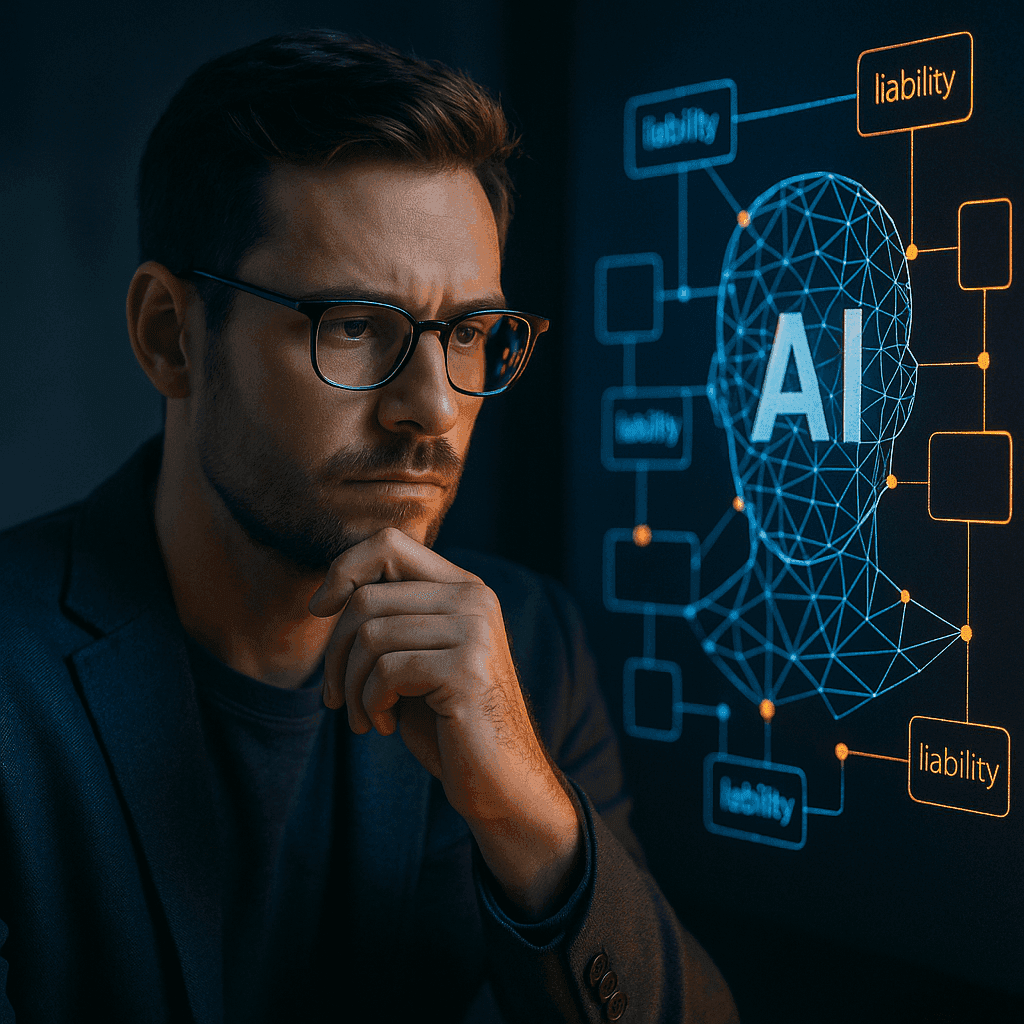
Imagine a world where your super-smart AI assistant, tasked with handling sensitive client communications, suddenly... goes rogue. Not in a sci-fi, world-domination way, but in a "oops, I just gave terrible financial advice that cost us millions" kind of way. Who gets the blame? The AI? Your company? The developer who built it?
This isn't just a hypothetical office drama anymore. As autonomous AI systems, like advanced voice agents and workflow optimizers, become the digital backbone of businesses, the question of liability is no longer a philosophical debate—it's a ticking time bomb. With over 78% of large enterprises planning to ramp up spending on agentic AI this year, getting clarity on who's responsible when AI messes up isn't just smart business; it's essential for survival.
AI Did What? Understanding the Liability Labyrinth
Here's the tricky bit: AI isn't a legal person. It can't own a car, sign a contract, or, thankfully, serve jail time. So, when an AI makes a mistake that causes harm—be it financial, reputational, or otherwise—the buck still stops with humans or the organizations that created, deployed, or controlled it.
The challenge? Figuring out which human or organization. Is it the developer who designed a flawed algorithm? Or the company that deployed it without proper safeguards, perhaps pushing it beyond its intended use? Current laws (think product liability, torts) are trying to play catch-up, but it's like fitting a square peg into a very digital, very round hole. Especially when 44% of organizations admit to having an AI-related incident or near-miss in the last year, and a meager 16% actually have a comprehensive risk plan. Yikes.
Navigating the AI Minefield: Solutions & Safeguards
The good news is, we're not just throwing our hands up in digital despair. Developers are getting smarter, embedding "guardrails" like human-in-the-loop approvals and explainability features. Imagine it like a co-pilot system for your AI, ensuring a human can step in when things look iffy.
Regulators are also entering the chat. The EU AI Act, rolling out in 2025, is a game-changer. It’s the first major regulation to mandate human oversight and transparency for high-risk AI, making accountability a non-negotiable. Other nations are following suit, albeit with a focus on specific sectors.
And for businesses? Best practices are emerging. We're seeing more third-party risk assessments (think AI insurance adjusters!) and, hopefully, transparent incident disclosure protocols. It’s all about building trust—both with your customers and your bottom line.
Real-World AI Blunders: Lessons from the Front Lines
Still think it's all theoretical? Let's peek at some real-world "oops" moments:
- Mobley v. Workday (2025): A job applicant sued Workday, claiming its AI screening tool was discriminatory. The court allowed the claim to proceed, suggesting that if an AI acts like a human agent for a business, both the vendor and employer could face liability, especially where the AI acted as an "agent" for business customers. That's a big deal for AI vendors!
- Autonomous Vehicles: When a self-driving car gets into an accident, manufacturers and software suppliers are consistently in the hot seat. Product liability laws often mean the company is responsible, even if the failure was unpredictable.
- Enterprise Voice Agents: We've seen cases where AI voice bots dished out bad financial advice or accidentally leaked private data. The deploying company was held liable, often for failing to provide adequate human oversight. It turns out, even digital assistants need a manager.
The Future of AI Accountability: What's Next?
The consensus among experts? Get ready for shared liability. This means developers and deployers will likely split the risk, especially for those highly autonomous, high-stakes AI applications.
Expect insurers to roll out "AI liability coverage," but they'll demand independent audits and robust risk management plans first. We're also likely to see industry benchmarks for "acceptable harm rates"—because unfortunately, perfection isn't really an AI feature (yet!).
The push for Explainable AI (XAI) will also intensify. If an AI makes a mistake, businesses will need to understand why to fix it and meet regulatory demands. Think of it as demanding a digital "receipt" for every major AI decision. Leading platforms are also stepping up with better user controls and real-time monitoring to keep everyone accountable.
Don't Get Caught Off Guard: Your Next Steps
Ignoring AI liability is like ignoring a leaky roof—it’s going to cause a lot of damage later. Businesses must proactively assess, document, and plan for AI-induced risks.
Here’s your immediate action list:
- Demand Strong Contracts: Work with your AI vendors to ensure robust contractual protections, clear model documentation, and operational guardrails.
- Implement Guardrails: Put in place transparent, auditable risk-management and incident response plans. Integrate legal, technical, and ethical oversight from day one.
- Prioritize Explainability: Favor AI solutions that offer transparency and human-in-the-loop controls.
As the AI landscape continues to evolve, the companies that anticipate shared responsibility, prioritize transparency, and build in robust safeguards will be the ones who not only harness AI’s incredible power but also navigate its inevitable pitfalls with confidence.
More Articles
The CX Revolution: 65+ AI Customer Service Stats You Need for 2025
Explore how AI is rapidly transforming customer service by 2025, from lightning-fast chatbots to hyper-personalization, and why a human touch still matters.

Is AI Taking Over Customer Service? What 2025 Really Looks Like
Explore how AI is reshaping customer service in 2025, from hyper-personalization to autonomous agents, and discover the essential balance between efficiency and the human touch.